

You Can Keep Everything Else on Track. So Why Do Your Own Plans Keep Falling Apart?

You remember appointments. You manage schedules. You make sure things get done. You plan ahead, solve problems, and stay on top of whatever comes next. When something needs handling, you handle it.
But somehow, the plans you make for yourself are different.
Then there's the diet you started on Monday.
The bedtime you promised yourself.
The exercise routine you were going to stick with this time.
The small changes you've been meaning to make for months.
Those are the plans that keep falling apart.
It's frustrating because you're not someone who gives up easily. You follow through on everything else, all day, every day.
So why does following through for yourself feel so different?
And why, when it doesn't work out, do you end up feeling guilty on top of it?
When did taking care of yourself become another thing to manage?
Think about everything you keep track of on an ordinary Tuesday.
The appointment you need to reschedule. The groceries you forgot to order. The school email you still haven't answered. What's for dinner. What needs to happen tomorrow.
Plus a dozen smaller things you never write down because you just remember them.
Somewhere in the middle of all that, you're also supposed to remember your own plans.
Eat a proper lunch. Get outside. Exercise. Drink more water. Get to bed earlier.
Consistently.
It sounds reasonable on paper. But it doesn't exist in isolation — it gets added on top of everything else.
At what point did looking after yourself become just another responsibility to stay on top of?
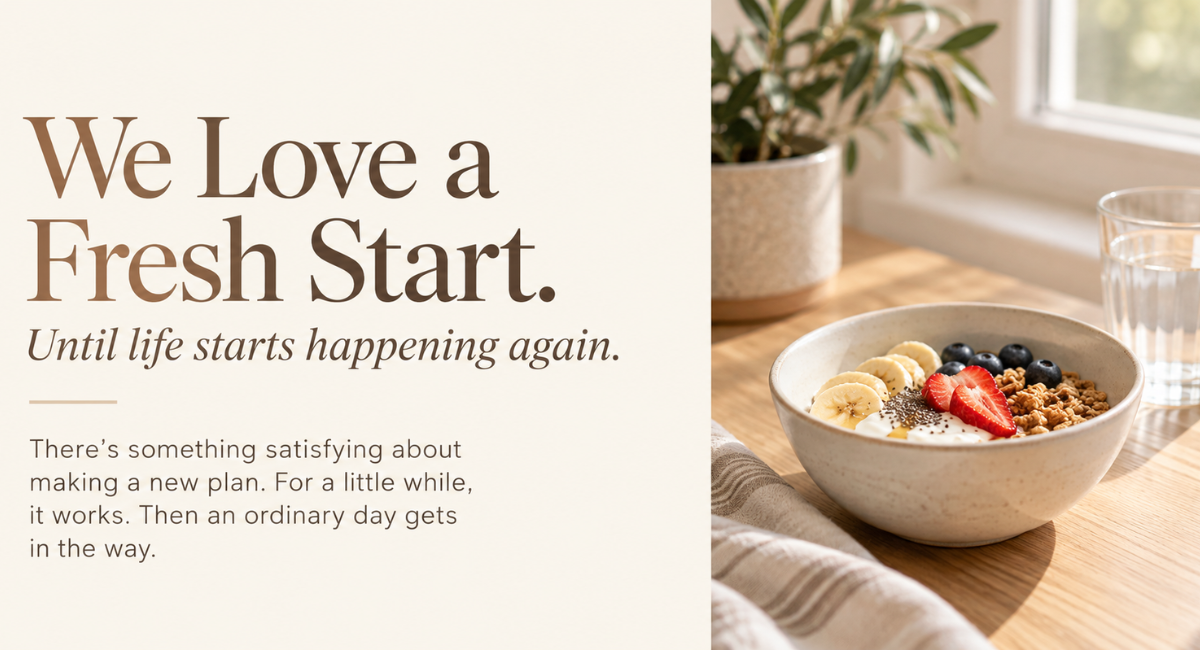
Sunday evening, you decide tomorrow will be different. You know what you're eating, when you're exercising, and that you'll stop scrolling so late. Maybe you've even bought the groceries and laid out your workout clothes.
For a little while, it works.
Then an ordinary day gets in the way. A meeting runs late. Someone needs something. Dinner takes longer than expected. You're tired.
You skip the workout. You stay up later than you meant to.
And instead of adjusting the plan, you start questioning yourself.
Why can't I just stick to something? I was doing so well. I'll start fresh on Monday.
It's strange how quickly one missed workout or one late night can turn into a judgment about our ability to follow through. We wouldn't necessarily respond that way to a work schedule — if a meeting got cancelled, we'd reschedule it. No drama.
But when our personal plans change, we can take it as a failure. Why do we give ourselves flexibility everywhere except in the promises we make to ourselves?
The guilt becomes part of the routine
There's the original plan. And then there's the guilt about not following it.
You wanted to go for a walk, but didn't. Now you're annoyed with yourself.
You wanted to eat differently, but the day got away from you. Now you're thinking about what you should have eaten.
You wanted to be in bed at ten. It's midnight, and you're still on your phone. Now you're dreading how tired you'll be tomorrow.
The day is technically over, but you're still mentally reviewing everything you didn't do. Tomorrow arrives, and you're carrying yesterday's unfinished promises along with today's responsibilities.
Slowly, looking after yourself stops feeling like something you want to do and starts feeling like another area where you're falling behind.
Maybe that's the thing worth paying attention to. Not just the habits themselves, but the pressure we've attached to getting them right.
What if we're trying to control too many things at once?
We tend to approach personal change like a project. Identify the problem. Make the plan. Set the deadline. Measure the progress. Stay consistent. And if it doesn't work, build a better plan.
That approach can genuinely help in other parts of life. But our days aren't controlled environments. Our energy changes. Our responsibilities change. Our sleep changes. Some days simply ask more of us than others.
Yet we build personal routines as if every day will be equally predictable. We make the plan for the version of ourselves with time, energy, motivation, and a quiet schedule. Then we expect the exhausted version to follow it without trouble.
When she can't, we blame her — instead of asking whether the plan ever left room for the life she actually has.
Maybe knowing what to do isn't the missing piece
Most of us don't need someone to explain that sleep matters. Or that moving our bodies matters. Or that eating regularly matters. Or that staying up too late can make tomorrow harder.
That information isn't hard to find. Books, podcasts, videos, meal plans, trackers, planners. Endless people telling us how to improve our lives. We can learn a new routine in twenty minutes.
But knowing something and making it part of an ordinary day are two different things.
Maybe the question isn't why we can't stick to another plan. It's why our plans are so hard to live with in the first place.
And yes, this happens to me too
I've been working on my upcoming 8-week BananaMamaLife program, and finishing it took much longer than I originally planned.
I had a schedule. I knew what needed doing and roughly how long it would take.
Then there was one more load of laundry. An unhappy child who needed me. Dinner I'd completely forgotten to plan. Snacks for the kids' game.
And somehow, every one of those things needed my attention before I could find my way back to my desk.
More than once, I stayed up way too late because that was finally when I could concentrate. The house was quiet. Nobody needed anything. I could actually sit down, write, and research without being interrupted.
And yes, there were mornings when I had coffee at 6 AM, before breakfast, before anyone else woke up. Just me, my coffee, and a little bit of quiet.
The funny thing is, I was working on a program about building better habits while struggling to keep some of my own.
I knew I needed more sleep. I knew coffee wasn't breakfast. I knew staying up until midnight wasn't doing tomorrow any favors.
But I also wanted to finish something that mattered to me. I wasn't struggling because I didn't know what to do. I was struggling to fit what I wanted to do into everything else that needed doing.
Even when you know better. Even when you're the one writing about habits.

We can run an entire household. Track responsibilities. Manage the unexpected. Show up for everyone else. Get an extraordinary amount done on the days we're exhausted.
But when it comes to our own habits, we often feel like we're starting from zero again.
Is it the number of things we're trying to change at once? The expectations we place on ourselves? How we react when something doesn't go to plan? Or simply that our own needs are the easiest things to push to tomorrow?
I don't think another list of things we should be doing answers that. It's worth looking at how we got here in the first place.
Because maybe the real question isn't why we keep falling off the plan. It's why we keep building plans that leave so little room for the lives we're actually living.
One Habit at a Time
I didn't figure any of this out by finding one more plan to follow.
My own journey started long before I began writing about habits. I started going through menopause at 32. I became a mom to twins at 36. And somewhere between hormonal changes, motherhood, work, and everything else, I had to figure out what taking care of myself actually looked like.
Not what it was supposed to look like on paper. What it looked like in my own life.
My weight didn't change overnight. I learned to love my body along the way, rather than waiting for a number on the scale to give me permission.
And I started paying attention to the smaller things. The habits that made a difference. The ones I could actually maintain. The ones that didn't require me to reorganize my entire life just to keep them going.
It happened slowly. One habit at a time.
And I still have days when the laundry wins, dinner isn't planned, and I stay up later than I intended.
That's part of why I created the 8-week BananaMamaLife program. Not to give women another rigid plan to follow, but to explore a different way of building habits through the changes that can come with our forties, menopause, motherhood, and everything else we're managing.
A way that requires effort and practice, but also makes room for real life. For the laundry. For the kids. For the occasional 6 AM coffee. And for all the days that don't go according to plan.
Because I don't think we need to spend the rest of our lives starting over every Monday. I think we need to understand what makes a habit worth keeping, what makes it difficult to maintain, and how to build something that can last beyond the excitement of a fresh start.
That's the conversation I want to have here. And it's the one I'll be sharing more about over the coming weeks.
With love, from someone still figuring it out too.
Maria
BananaMamaLife ♡